Quant exercise
Mobile money and the unbanked
How is mobile money reaching unbanked adults in Indonesia and the Philippines, and where does that leave the opportunity for banks?
Background
e-Conomy SEA, Google, Temasek and Bain’s research programme on Southeast Asia’s internet economy, argued in its 2021 edition that e-wallets could help the region’s unbanked skip traditional banking:

So I asked
How is mobile money actually reaching the unbanked, and what does that mean for banks?
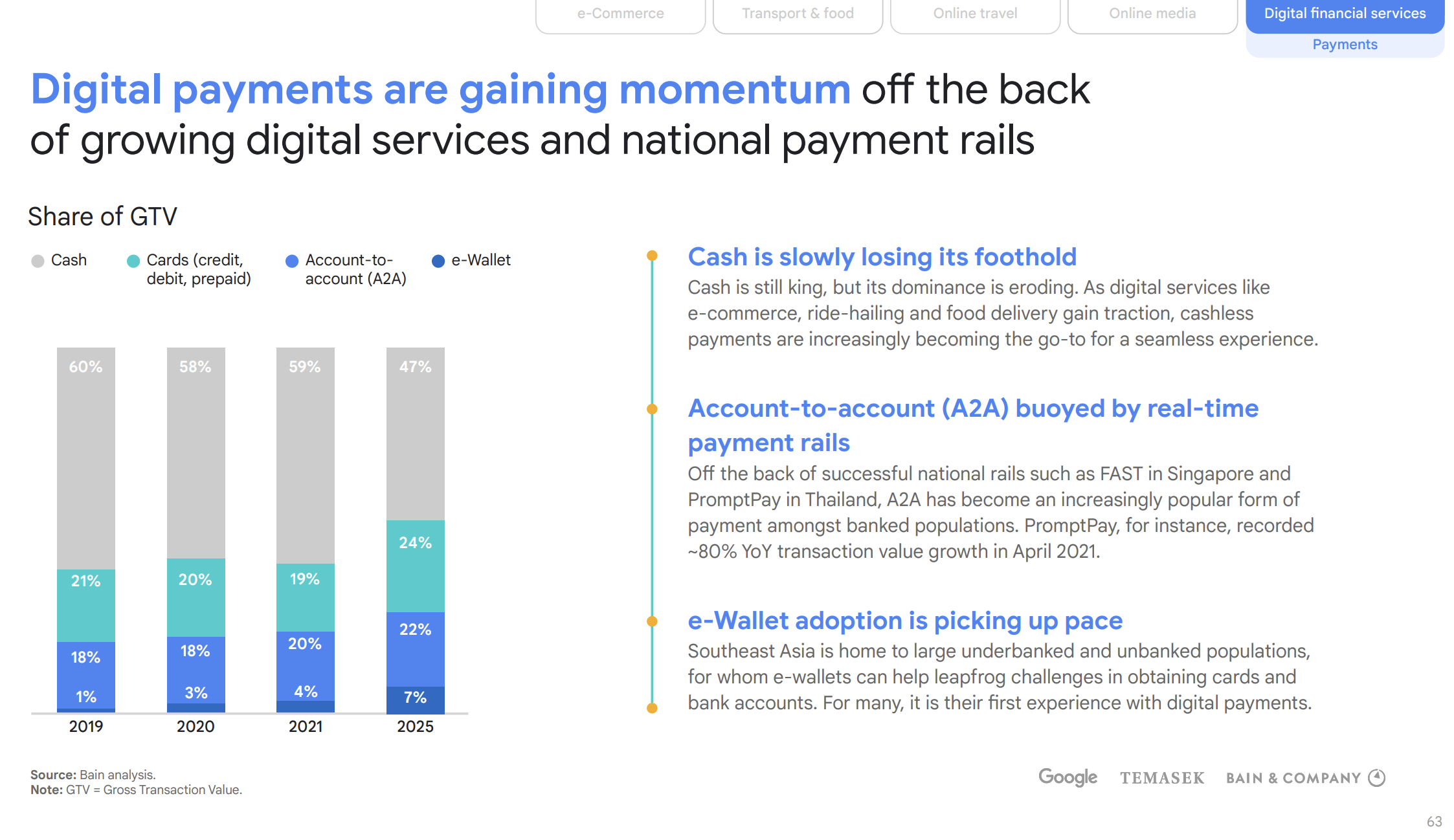
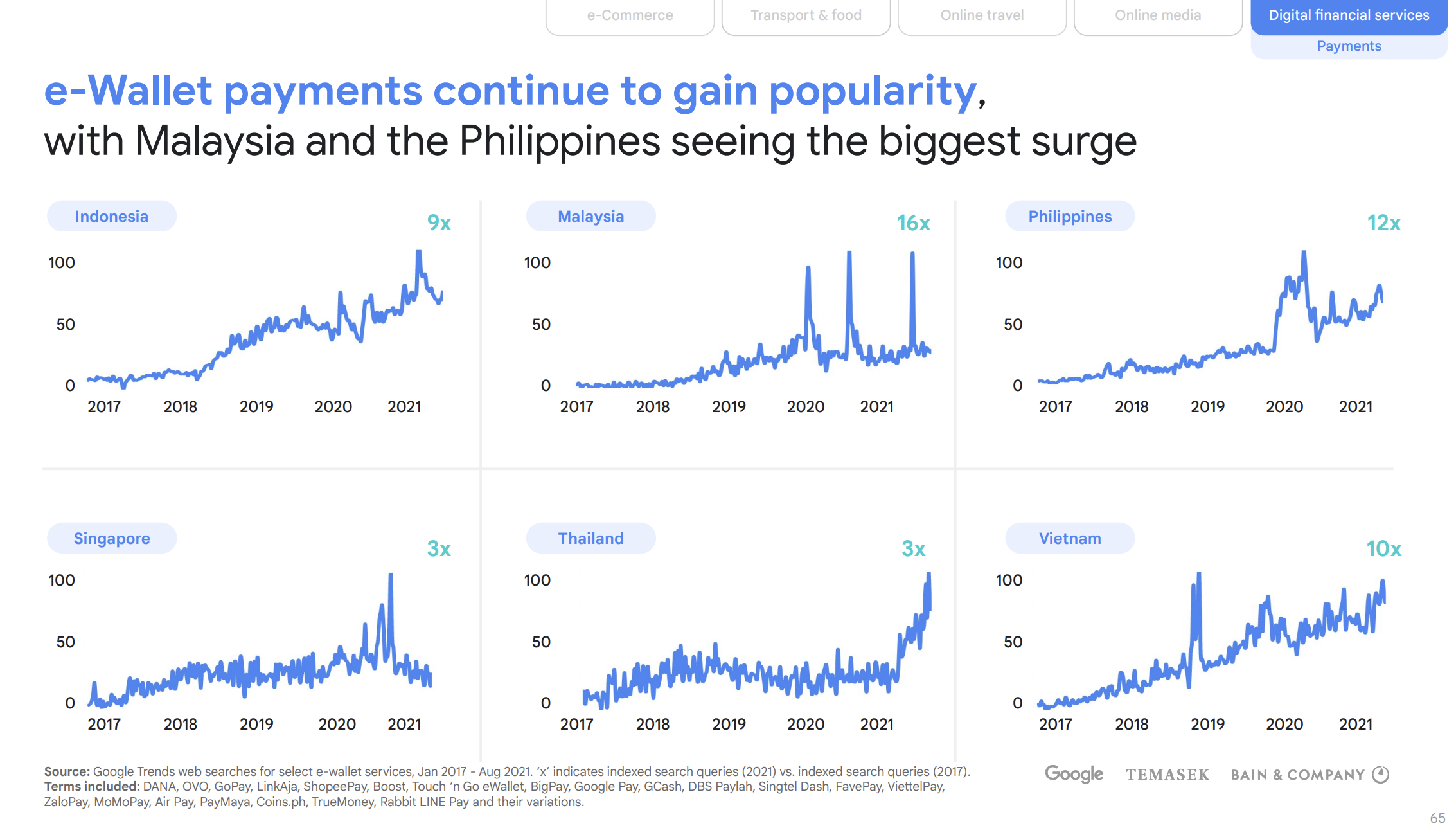
Google, Temasek, & Bain & Company. (2021). e-Conomy SEA 2021: Roaring 20s: The SEA digital decade. https://www.bain.com/insights/e-conomy-sea-2021/
Research questions
Research objective
To understand how mobile money is reaching unbanked adults in Indonesia and the Philippines, and where that leaves the opportunity for banks.
RQ1. Who is mobile money reaching instead of banks?
H1: Younger, lower-income and less-educated adults are more likely to hold only a mobile money account.
RQ2. Do mobile-money-only users pay, save and borrow differently from bank account holders?
H2a: Mobile-money-only users make digital payments at similar rates to bank account holders.
H2b: They are less likely to save or borrow formally, through either a bank or mobile money.
RQ3. Why are the unbanked unbanked?
H3: Among the unbanked, structural barriers like access outweigh trust and attitudes.
RQ4. How reachable are the unbanked through digital channels?
Approach
Data source
- Global Findex 2025 microdata (World Bank), fieldwork in 2024.
- About 1,000 adults aged 15+ per market, 199 variables each.
- Read alongside the codebook, questionnaire and the World Bank’s variable script.
Steps
- 1
Data audit & prep
- Used Claude to read and find relevant columns based on research objective & questions, and to ascertain data completeness for each market
- Discovered that data from Vietnam and Thailand were unsuitable to address my research questions, as # of mobile money-only respondents was too few to analyse (6 in each market)
- Changed the definition of ‘unbanked’; created new combined variables (e.g. age bands, digitally reachable); used Claude to recode data
- Used Claude to build the workbook (consolidate relevant columns from each country’s datasets)
- Applied official survey weights so each sample represents the adult pop
- Used Claude to read and find relevant columns based on research objective & questions, and to ascertain data completeness for each market
- 2
Data validation
- Using the data from the newly created workbook, checked against published World Bank figures to ensure veracity of data (Indonesia acc ownership figure)
- 3
Data analysis
- Built necessary weighted tables to address each research question (SUMIFS & pivots)
- Analysed data
- Ran bivariate analysis for RQ1 and RQ2
- Tested each hypothesis against the data
- Built narrative & prompted Claude to generate the necessary charts based on data tables
Findings
An estimated 155m adults across Indonesia and the Philippines have no bank account
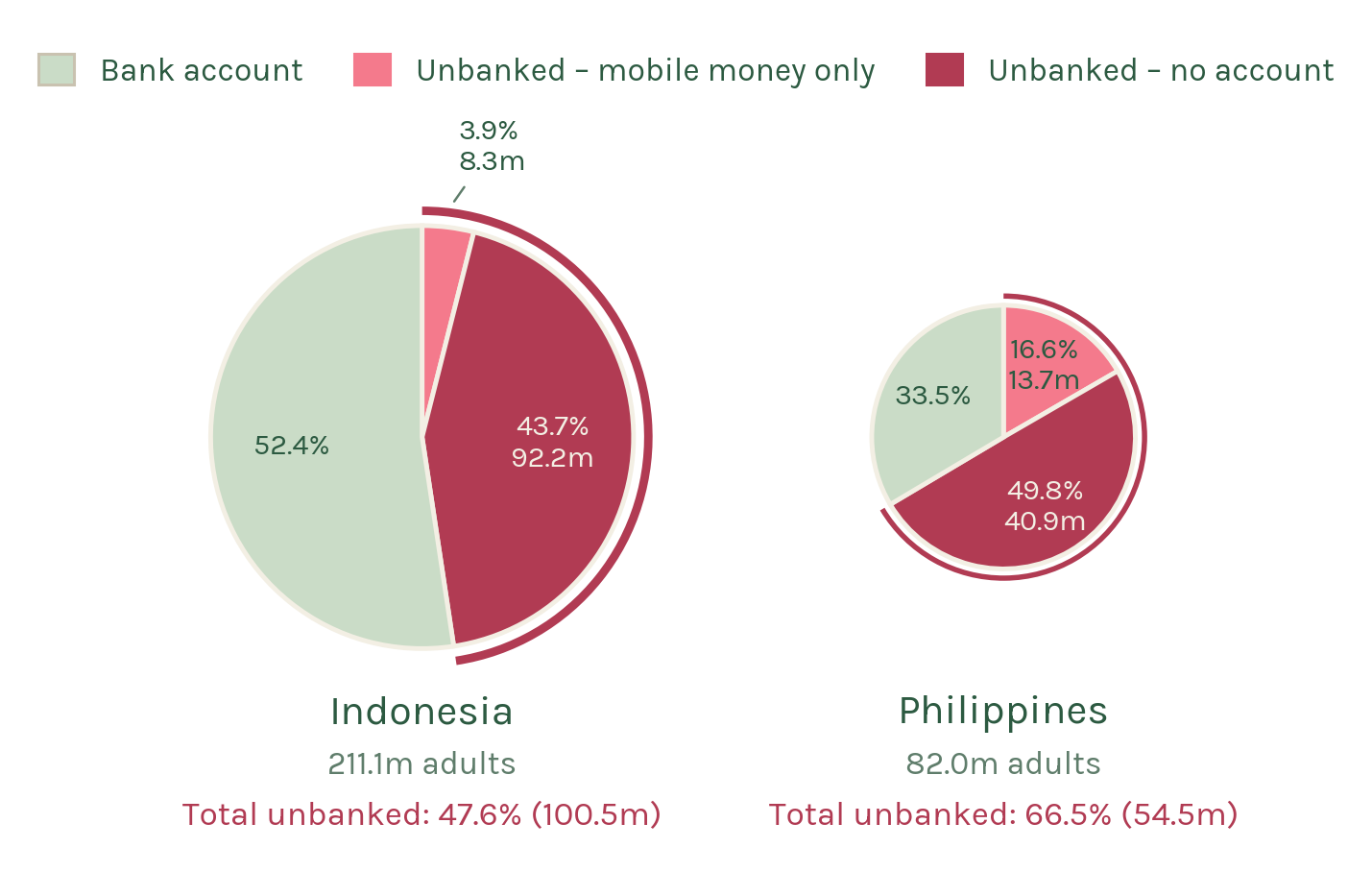
22m are reached by mobile money; 133m have no account at all. Pie area proportional to adult population (15+). Unbanked = no account at a bank or similar financial institution. Weighted estimates × adult population (WDI, 2023). Vietnam and Thailand excluded: too few mobile-money-only respondents to analyse. Source: World Bank (2025), The Global Findex Database 2025 [Data set].
Findings
Mobile money is reaching the young, educated and better-off unbanked — not the poorest
Overall, the unbanked are poorer and less educated than bank customers; in Indonesia, they are also older.
| Philippines | Indonesia | |||||
|---|---|---|---|---|---|---|
| Bank account holdersn = 339 | All unbankedn = 661 | Reached by mobile moneyn = 150 | Bank account holdersn = 564 | All unbankedn = 504 | Reached by mobile moneyn = 40, indicative | |
| Median age | 36 | 33 | 23 | 35 | 41 | 22 |
| Secondary education or more | 73% | 66% | 90% | 73% | 48% | 88% |
| In the poorest 40% | 29% | 45% | 24% | 34% | 46% | 34% |
Weighted. Bank account holders shown for reference. Income = within-country fifths. Indonesia mobile money only n = 40; indicative. Full distributions: appendix A1 to A3. Source: World Bank (2025), The Global Findex Database 2025 [Data set].
Findings
Mobile money users pay digitally at least as often as bank customers
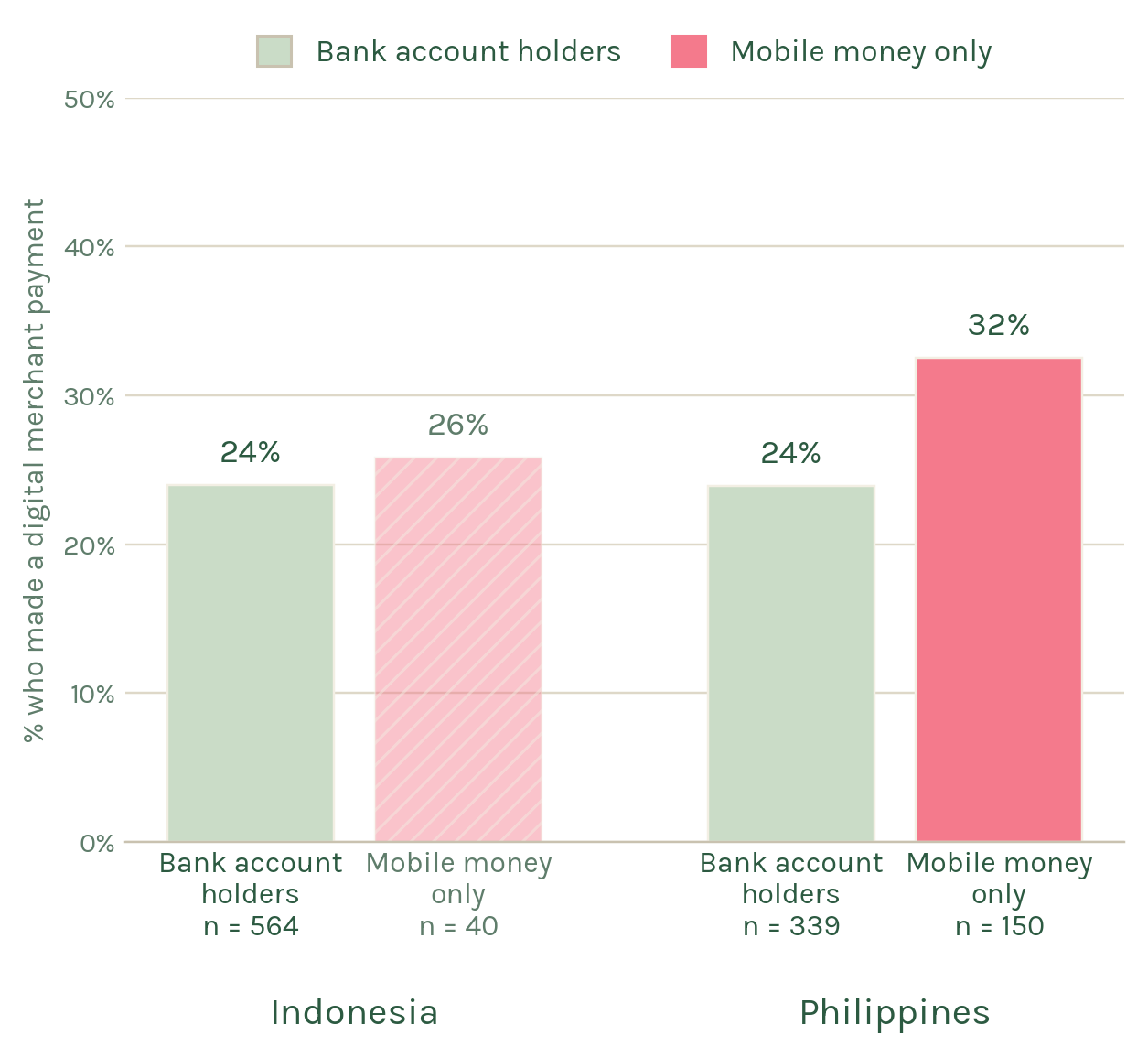
Digital merchant payment = paid in a shop or online with a card or mobile phone in the past year. Indonesia mobile money only n = 40; indicative. H2a supported. Source: World Bank (2025), The Global Findex Database 2025 [Data set].
Findings
Mobile money users save as much as or more than bank account holders do
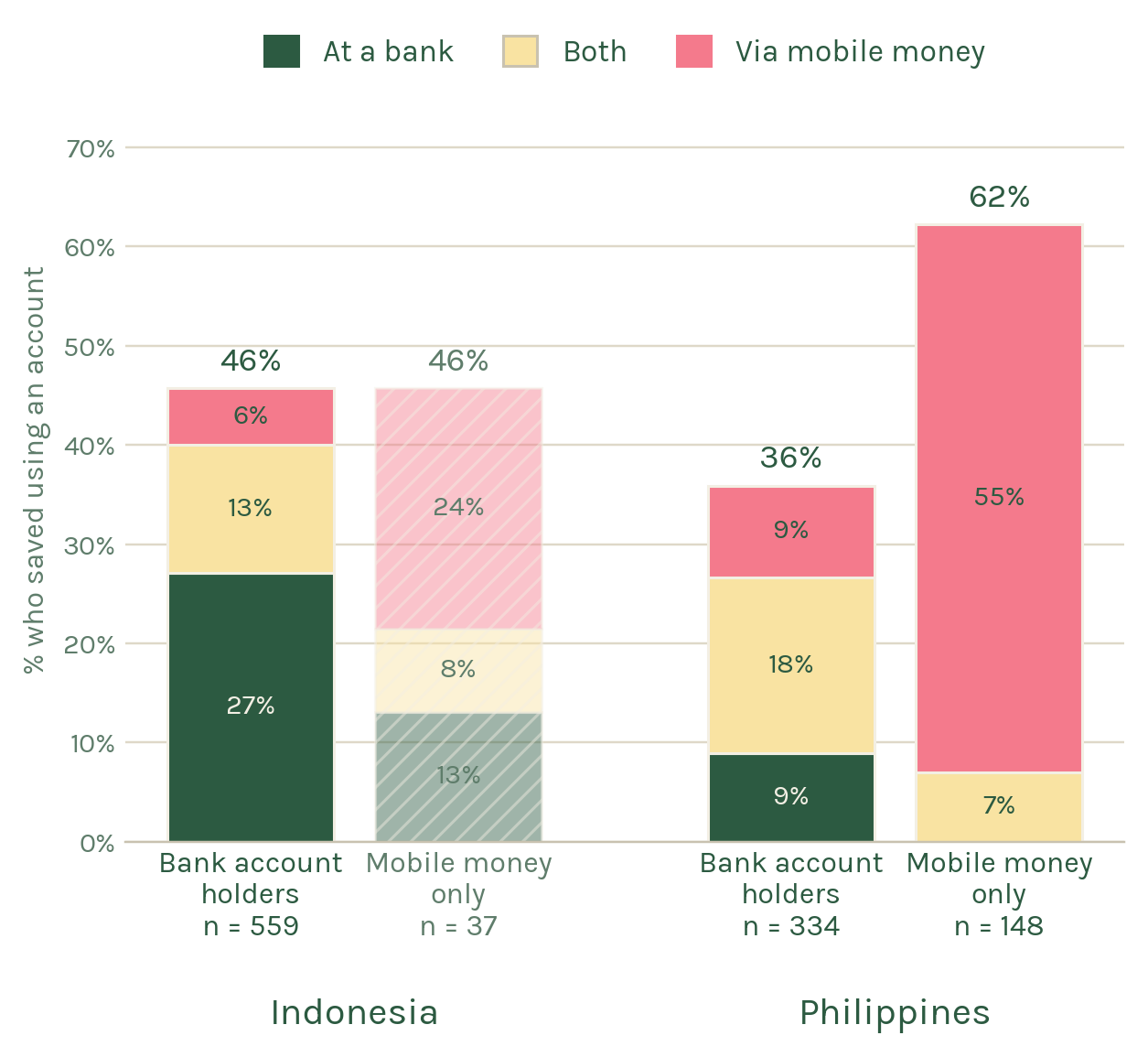
Weighted % of each group. ‘Using an account’ = at a bank or similar institution, or via mobile money. The questionnaire allowed ‘at a bank’ answers from people saving through a family member’s account. H2b not supported for saving. Source: World Bank (2025), The Global Findex Database 2025 [Data set].
Findings
Credit is the gap: mobile money users borrow far less through any account
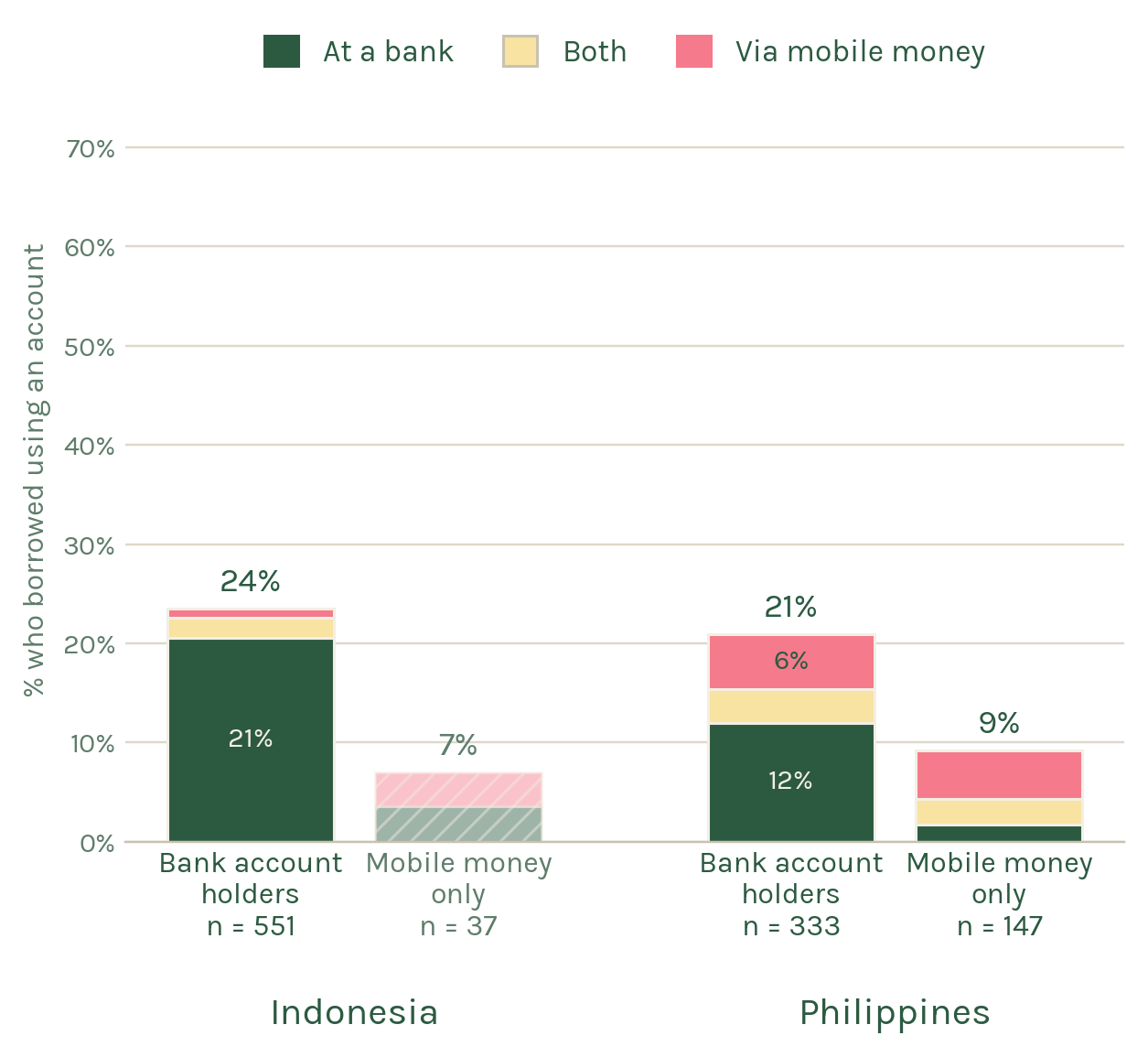
Weighted % of each group. ‘Using an account’ = at a bank or similar institution, or via mobile money. Indonesia mobile money only n = 37; indicative. H2b supported for borrowing. Source: World Bank (2025), The Global Findex Database 2025 [Data set].
Findings
Affordability, more than access or trust, is keeping the unbanked out of banks
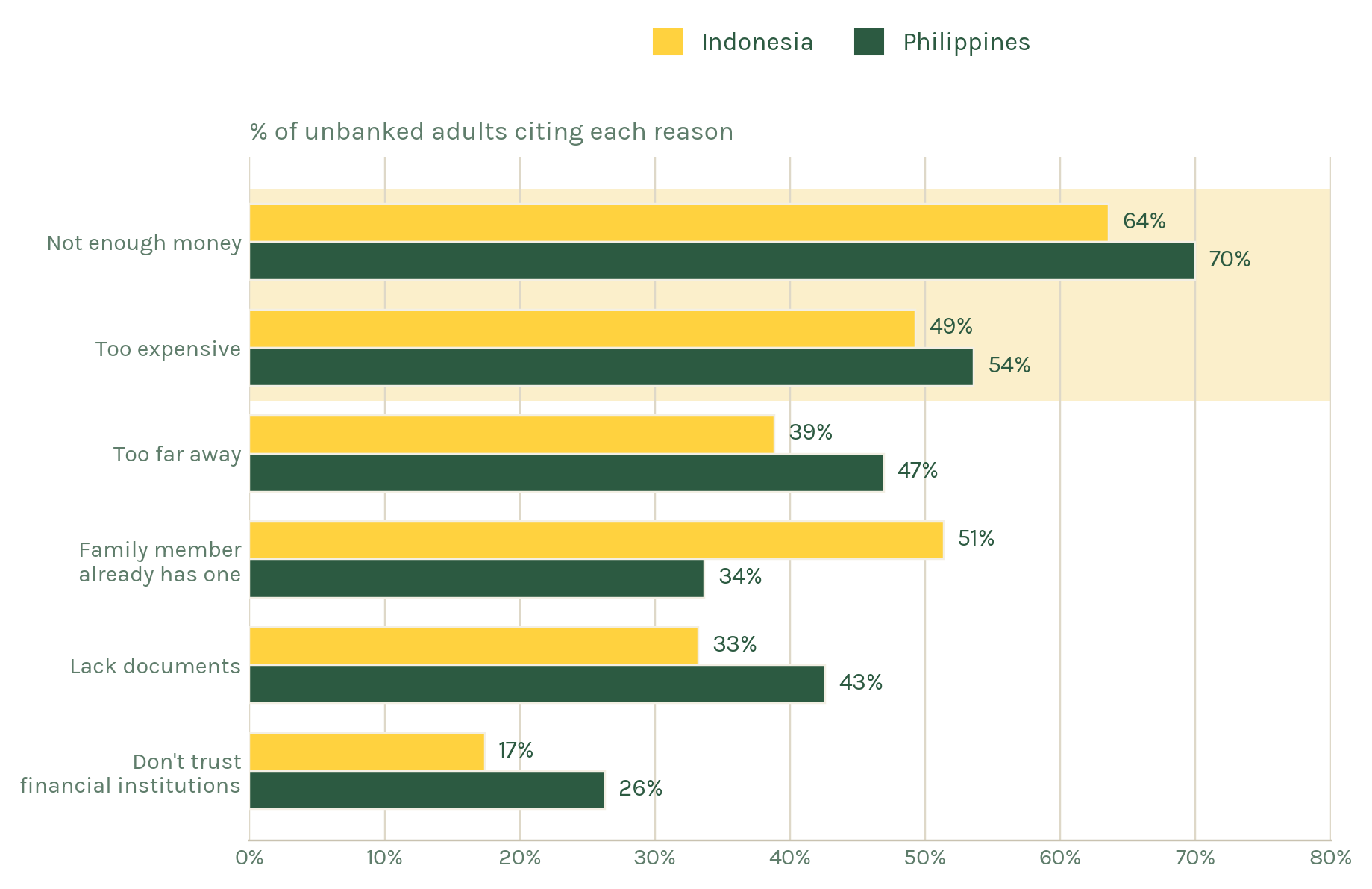
% of unbanked adults (no bank account) citing each reason; multiple reasons allowed; ‘don’t know’ counted as no. Indonesia n = 504; Philippines n = 661. H3 partly supported: structural barriers outweigh trust, but affordability leads, not access. Source: World Bank (2025), The Global Findex Database 2025 [Data set].
Findings
86m unbanked adults could open an account through an app, including 66m whom mobile money hasn’t reached
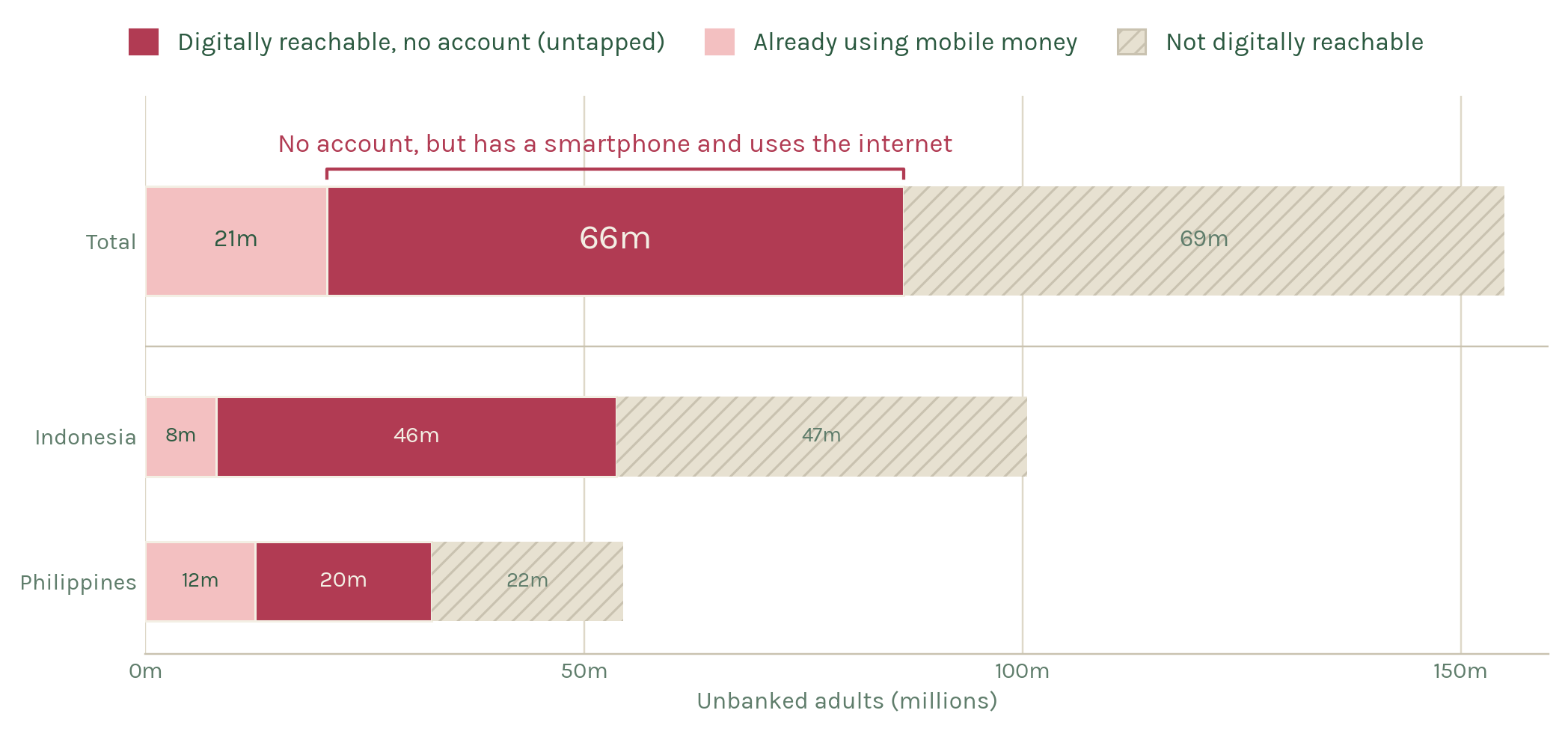
Digitally reachable (my definition) = main phone is a smartphone and used the internet in the past 3 months. Weighted shares × unbanked population. Shows ability to use an app, not intent to open an account. Source: World Bank (2025), The Global Findex Database 2025 [Data set].
Conclusions
Two unbanked segments, two opportunities for banks
| Mobile money users without a bank | No account at all | |
|---|---|---|
| Who they are | Young, educated, better-off | Relatively older, less educated, poorer |
| What we found | Affordability is the main barrier, not trust | |
| Wallets have won payments and everyday saving; credit is the gap | 66m are digitally reachable but mobile money hasn’t reached them | |
| The opportunity |
|
|
Limitations and next steps
Limitations
Data
- Using open source data -
- Limited familiarity with the methodology & questionnaire
- Missing context & questions (e.g. fin11 question is missing from questionnaire) → made assumptions to fill in gaps
- Only 2 markets → not representative of SEA
- Only 1 year → can’t measure change over time
- Limited data & definitions of mobile money
- No formal significance tests
Definitions / recoding
- Unbanked = no bank account: follows Bain, Google and Temasek, 2019
- Figures are therefore higher than the World Bank’s “unbanked” estimates.
- “Digitally reachable” is my own definition: combines smartphone and internet use; shows ability to use an app, not intent to open an account
Process
- Limited time and familiarity with the survey’s design:
- Many relevant variables are still unexplored
- Leaned more heavily on Claude than I would have liked
What I’d do next
- Spend more time with the data
- Investigate whether there are differing reasons for the 2 unbanked populations for not owning a bank account
- Explore other variables in the dataset
- Run regressions, to understand the effect of multiple overlapping factors at once
- Find areas of comparison esp against Vietnam data
- Go long / wide
- Look at Global Findex 2021 data, to compare against e-Conomy 2021 report, and measure change over time
- Do secondary research to go deeper into each market
References
World Bank. (2025). The Global Findex Database 2025 [Data set]. https://www.worldbank.org/en/publication/globalfindex
Google, Temasek, & Bain & Company. (2021). e-Conomy SEA 2021: Roaring 20s: The SEA digital decade. https://www.bain.com/insights/e-conomy-sea-2021/
Analysis and any errors are my own.
Appendix
A1 · Age distribution
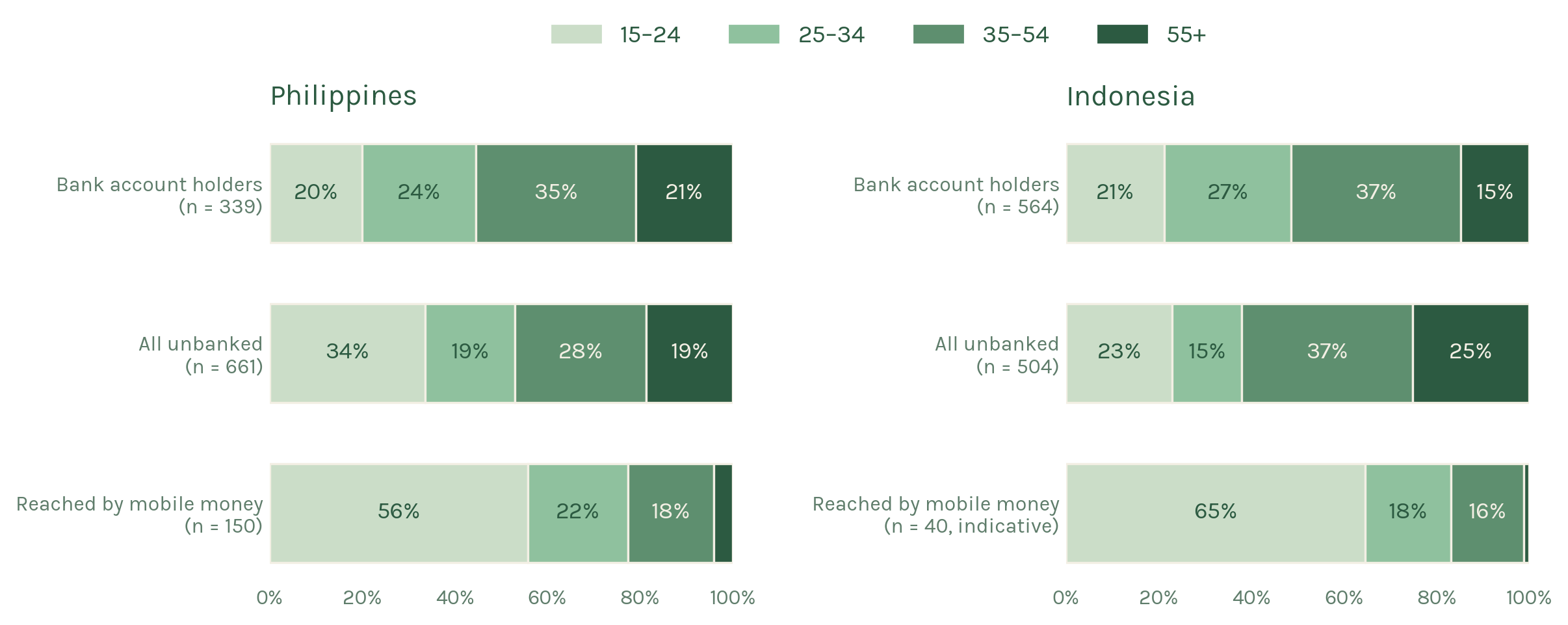
Weighted % of each group; each bar adds to 100%. Bank account holders shown for reference. Income = within-country fifths. Indonesia mobile money only n = 40; indicative. Source: World Bank (2025), The Global Findex Database 2025 [Data set].
Appendix
A2 · Education distribution
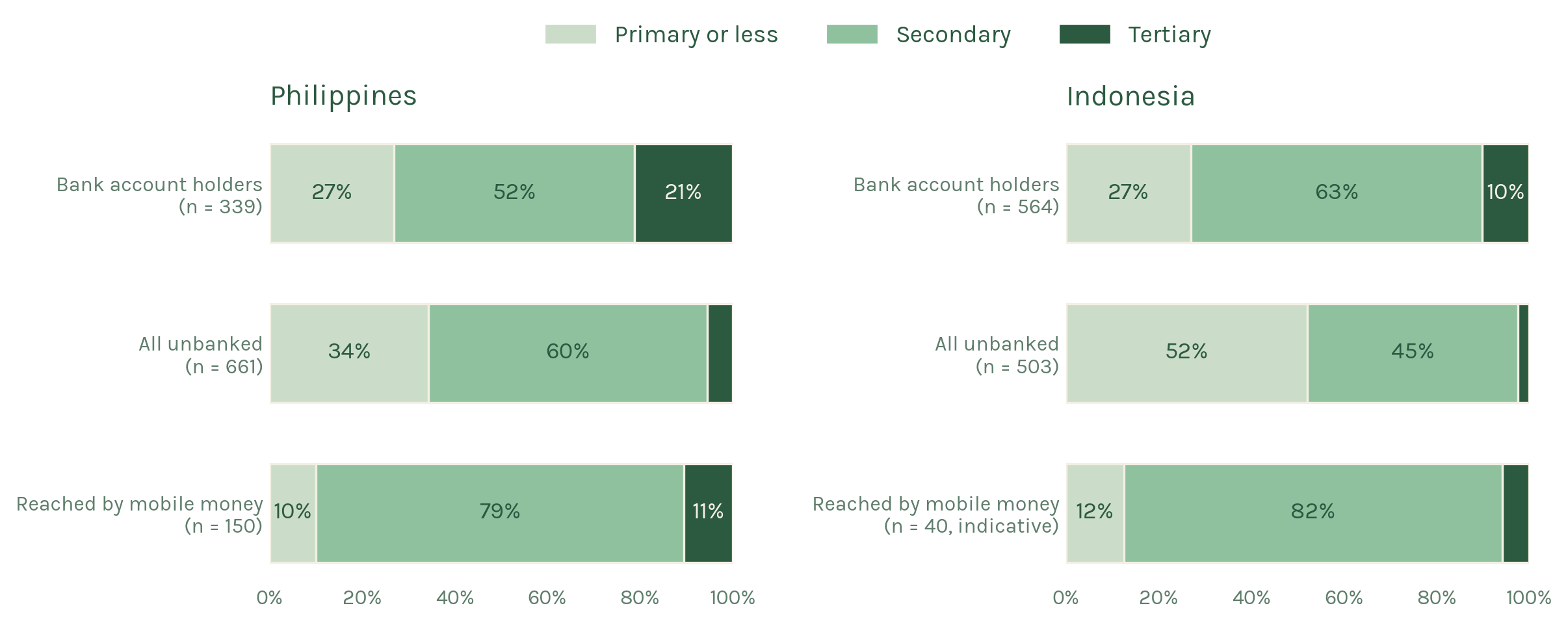
Weighted % of each group; each bar adds to 100%. Bank account holders shown for reference. Income = within-country fifths. Indonesia mobile money only n = 40; indicative. Source: World Bank (2025), The Global Findex Database 2025 [Data set].
Appendix
A3 · Income distribution
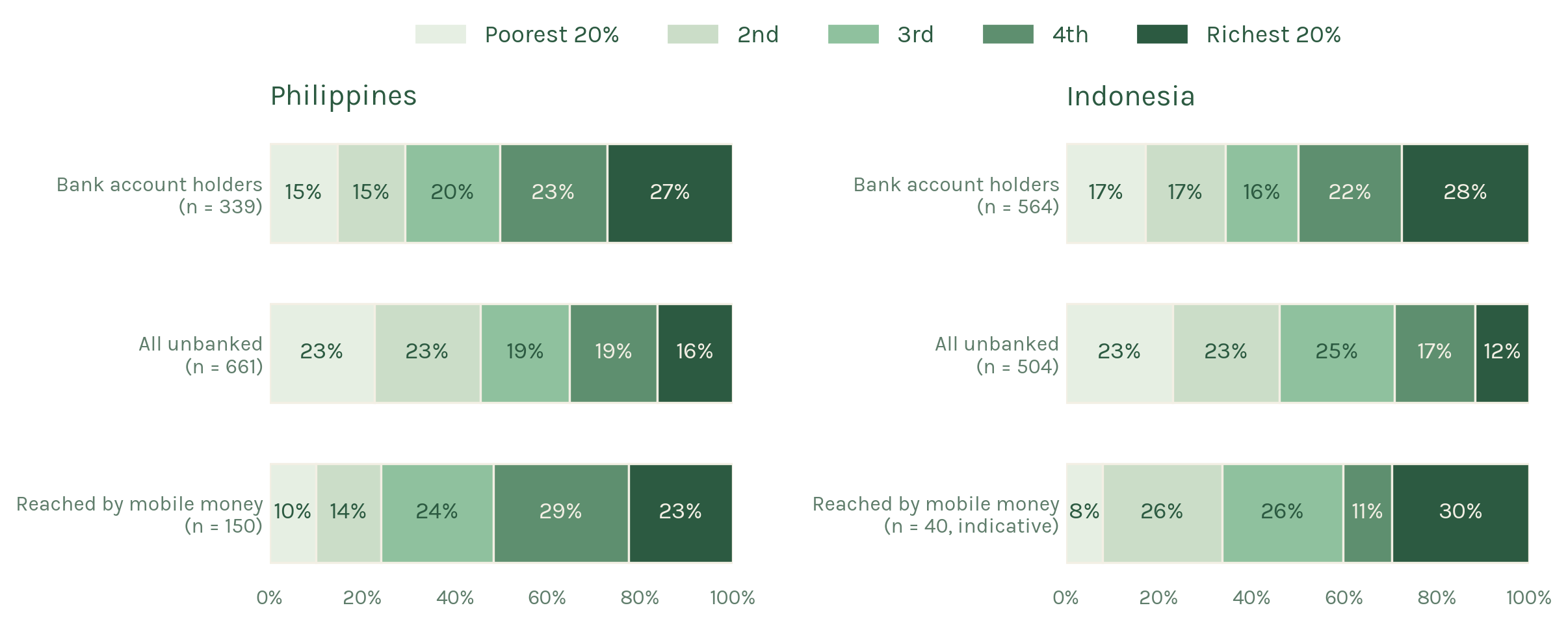
Weighted % of each group; each bar adds to 100%. Bank account holders shown for reference. Income = within-country fifths. Indonesia mobile money only n = 40; indicative. Source: World Bank (2025), The Global Findex Database 2025 [Data set].